
Programming Cocktails Theory
The main theory that was developed to model and analyse the combination and mixtures of programming languages, libraries, frameworks and tools is the Programming Cocktails Theory. It is based on an ontology named OntoCoq (see figure below) that models the main concepts behind the use and the relationships of such programming technologies (Ingredients, in the theory’s parlour).
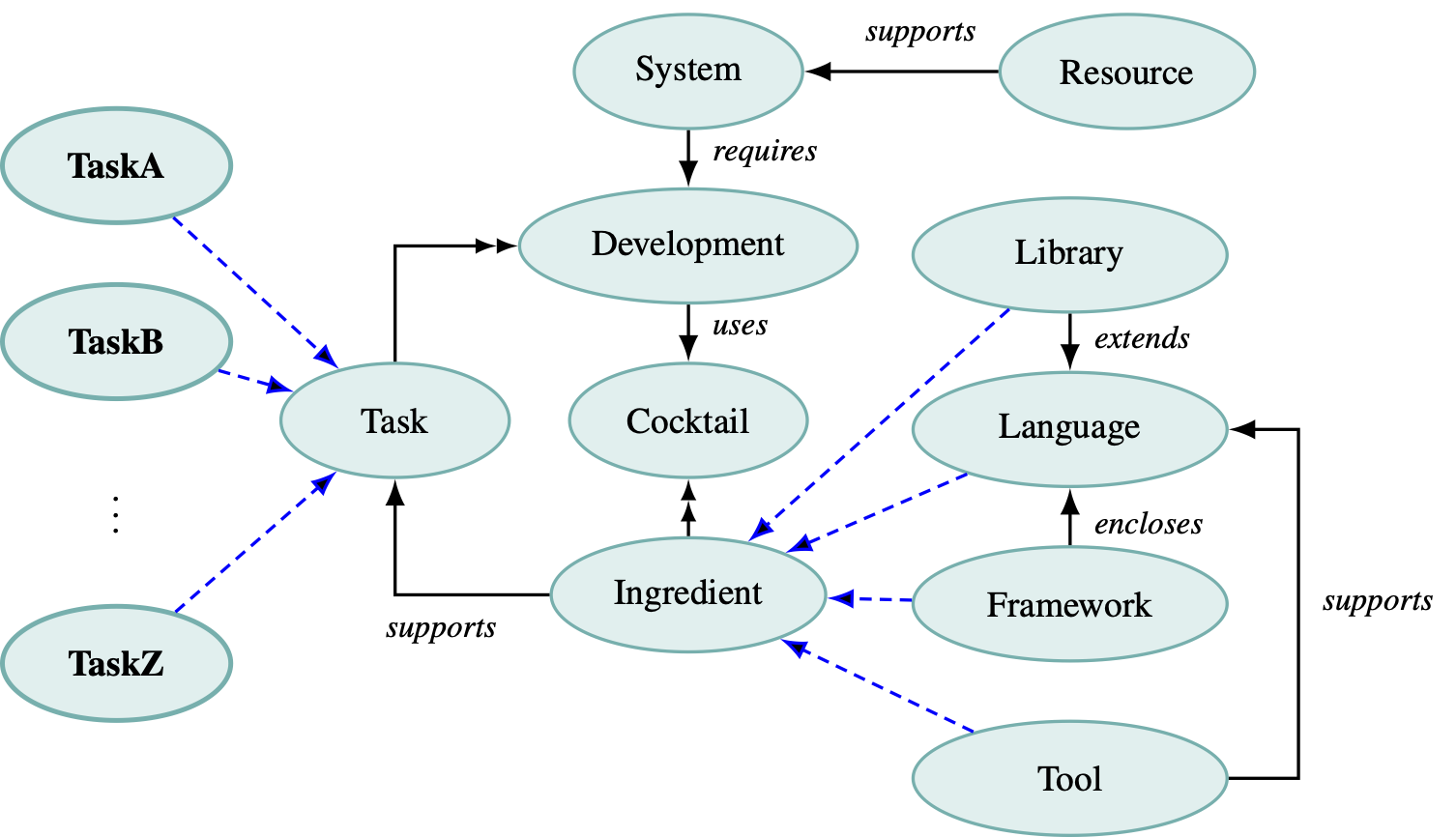
This ontology was the result of an analysis based on a survey from 2023 that had the participation of several IT companies with offices in Portugal. It allowed the organization of the Theory’s main concepts and the relationships between them. The instantiation of OntoCoq’s conceptual model resulted in the Cocktail Identity Cards, as shown in the figure below.
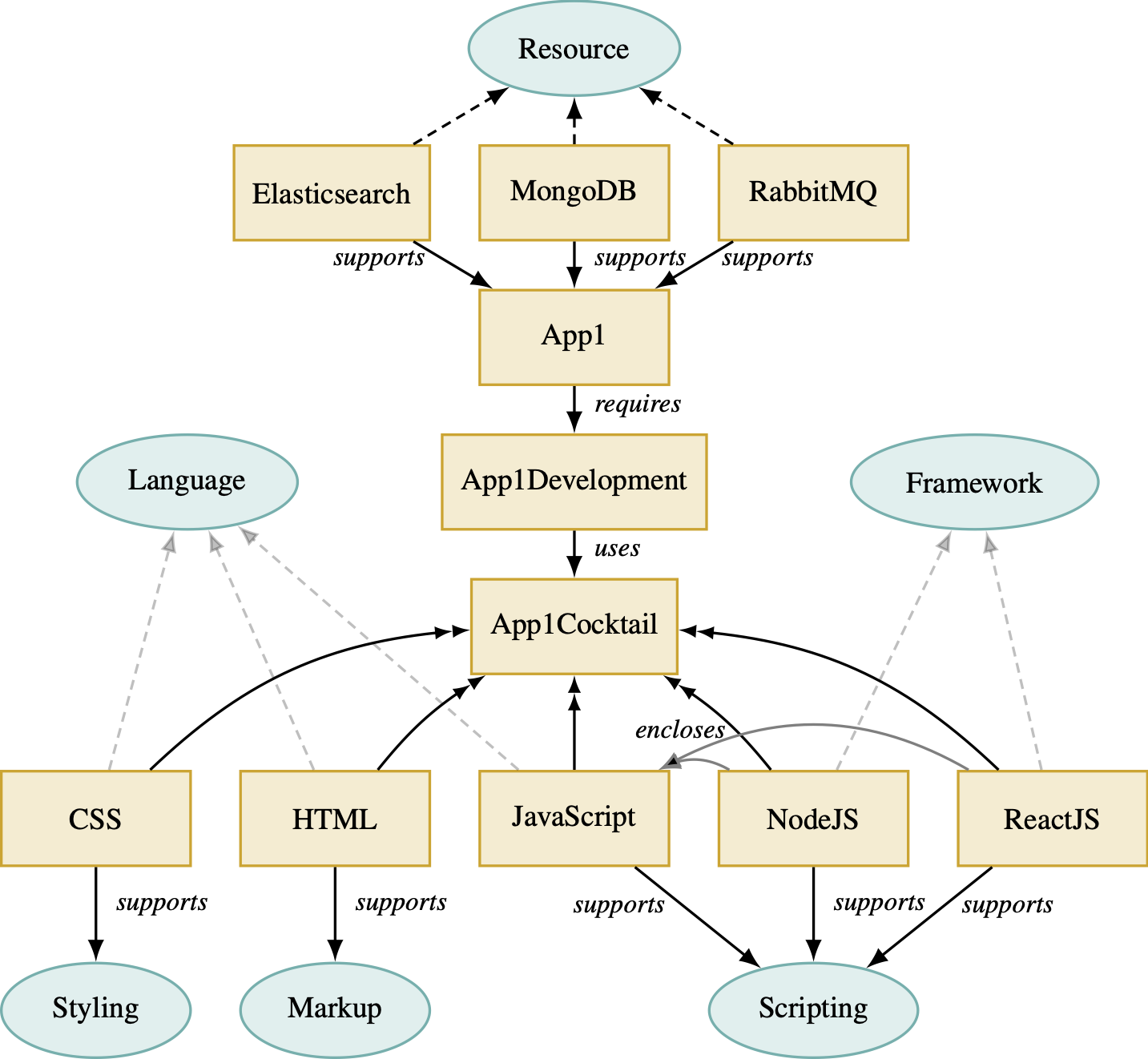
The Cocktail Identity Cards provided a representation for quick identification of a Cocktail’s Ingredients, their relationships and to which Tasks they were applied. It also provides a visual model that can be augmented with quantitative or qualitative metrics, such as costs, risk, dependency levels, etc.
More details about the overall Programming Cocktails Theory and its uses can be found in its publications
Cognitive Entropy Framework
The original intent for the Programming Cocktails Theory was to allow the organization of the different programming technologies that sometimes mix well together, and sometimes don’t. In fact, despite the possibility for different types of analysis that the Cocktails Identity Cards created, the original idea was to obtain some kind of metric that would represent how chaotic the use of these technologies could become, when combined in a single cocktail.
With the structural basis obtained with the development of the Cocktail Identity Cards, all that was left to do in order to achieve this goal was to find this metric. The Cognitive Entropy Framework, which is still in development, was the answer to this problem. It first models individual Ingredients’ cognitive features as a Production System Model (as first demonstrated by Sweller, the creator of the Cognitive Load Theory) and applies Shannon’s entropy calculation to obtain a quantitative metric for the cognitive entropy that it implies in use. By aggregatin all Ingredient’s cognitive models into their Cocktail, it is possible to figure out how chaotic (meaning, how entropic) a Programming Cocktail can be.
Given it is currently in development, this the Cognitive Entropy Framework has less results than the Programming Cocktails Theory. Nonetheless, this is about to change soon.